If you don’t know what to do in the gym or you’ve never stepped foot in one before, our guide will help!
Once you’ve read through this guide, you’ll know everything there is to know about working out in the gym and smashing your fitness goals.
BEFORE YOU START
HEALTH REQUIREMENTS
The gym is designed to give everyone the tools they need to reach their dream fitness goals. Whether it’s to tone up or build strength, anyone is welcome to train in the gym, but before starting your fitness journey, you may be asked to disclose any medical conditions. This helps personal trainers to tailor a routine that suits you.
Here are a few examples that you may be asked to disclose:
- Any existing heart conditions
- Ongoing medical conditions like diabetes
- Any major operations you’ve had in the last 12 months
- Whether a doctor has advised you to abstain from exercise in the past
GYM INDUCTIONS
A gym induction is a brief tour of the gym’s facilities. It covers gym etiquette (which can vary between clubs), how to use the machines, and how you can access each area of the gym.
A good induction is key to getting you started on the right foot. The staff that run inductions will always have tips and advice that could save you a lot of hassle later on, like the best times to use what equipment and what exercises are great for beginners.
THE BEST TIME TO GO TO THE GYM
One question every new-starter asks is “what’s the best time to go to the gym?”
Morning is often hailed as the best time to fit in a workout, as it can reduce stress levels and leave you energised for the rest of the day. However, it all depends on your schedule.
A circadian rhythm is your internal clock, the one that causes you to fluctuate between alert and sluggish throughout the day. If you consider yourself a morning person, it should be easy to motivate yourself for an hour in the gym before work. But, if you can’t get anything done before your 9 am coffee, don’t beat yourself up about it — hit the gym on your way home instead, shift allowing.
There really is no ‘best time’ to exercise, it all depends on your body, so listen to it and hit the gym when it’s most convenient for you.
WHAT TO WEAR AND TAKE WITH YOU
If you’re truly looking to power through your session and achieve your peak performance, you’ll want to come prepared.
Here’s a list of gym bag essentials:
- Gym-appropriate training gear (avoid denim or replica shirts)
- Gym shoes (sturdy trainers work best; avoid weak canvas shoes)
- Sweat towel (for wiping down equipment after you use it)
- Towel and shampoo (for a post-workout shower)
- Post-workout snack
- Water bottle
WARMING UP
If you’re feeling self-conscious on your first gym visit, your initial instinct might be to skip straight to the treadmill or weight machine and ‘prove your worth,’ but this is a rookie mistake. One of the most important parts of a good workout is to properly warm up.
Warm-ups are crucial as they prepare your body for the demands of exercise, loosening up the muscles and reducing the risk of injury. This also means you’re less likely to pull a muscle during your workout and minimises the chances of lactic acid building-up, which can lead to cramping.
YOUR FIRST GYM SESSION
WHERE TO START
Once you’re warmed up and fully prepared, it’s time to train. But where do you begin? If you’re unsure of how to start at the gym, we’ve got you covered.
Good workouts aren’t improvised: they’re meticulously planned ahead of time. Those people who seem to glide from treadmill to tricep press are actually following a well-kept schedule, tailor-made to get the most out of each session.
So what’s the secret to mapping out a workout that works for you? It’s understanding what each piece of gym equipment is designed to do — and how it can help you reach your goals
GYM MACHINES EXPLAINED
Your induction should include a brief ‘how-to’ for each machine. If there’s one that was missed out and you want to use it, don’t try to figure it out on your own: ask a staff member to show you how to use it properly.
Using a machine incorrectly can damage the equipment or in extreme circumstances can lead to injury — not a great way to start your time at the gym.
Here’s a quick breakdown of some machines you can expect to find in most gyms:
SECTION 1: CARDIO MACHINES
BEST FOR: Losing weight; strengthening your heart and lungs.
TREADMILL — A running machine that can provide a great workout to improve your cardiovascular strength. You can adjust incline and pace depending on what type of workout you’re looking for.
ELLIPTICAL CROSS TRAINER — A dual-action trainer that works both your upper and lower body in tandem. Provides a low-impact way of exercising your hamstrings, quads, glutes, chest, back, triceps and biceps.
ROWING MACHINE — Simulates the movements of a rower’s body, swapping the water and oars for a handle and chain. A fantastic full-body workout that puts emphasis on your core and melts away fat.
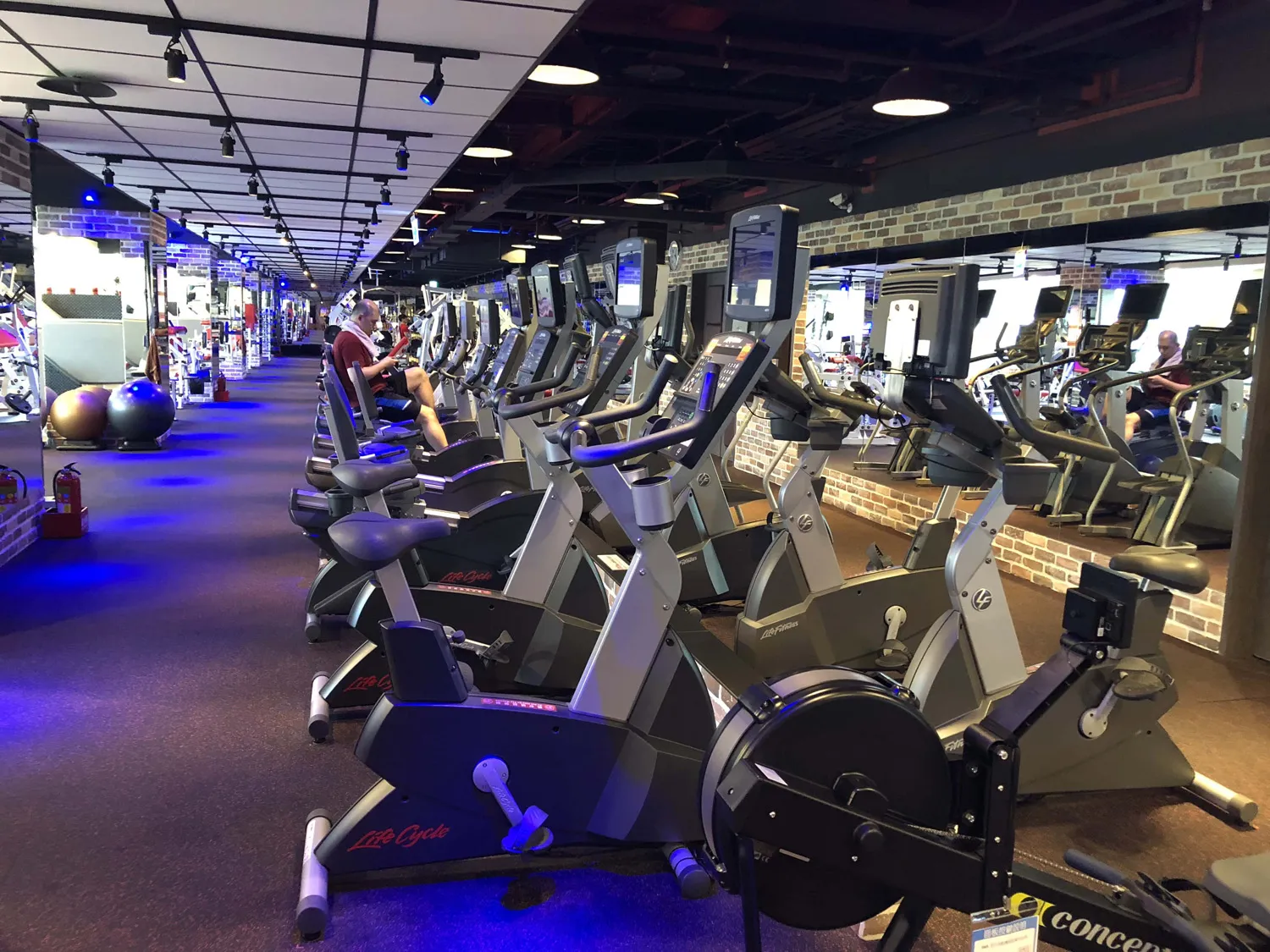
EXERCISE BIKE — A sit-down cardio machine that works all of your leg muscles. You can increase resistance to strengthen and tone your legs.
STAIR CLIMBER (OR ‘STEPPER’) — Like a treadmill, only with steps! Provides a workout that’s easy on your joints but still works every muscle in your legs.
SECTION 2: RESISTANCE AREA
BEST FOR: Building strength and mass; muscle toning.
CHEST PRESS — Simulates a barbell or dual-dumbbell press in a more controlled environment. Sitting at a 45-degree incline is a great way to engage your upper chest muscles without feeling overwhelmed.
CHIN-UP MACHINE — Designed to help you become stronger simply by using your own bodyweight. Beginners can use the assisted mode to help make things a little easier.
BICEP CURL — A machine that isolates a workout to just your biceps.Good for toning or developing muscle in your upper arms.
TRICEP PRESS — Works your triceps, along with your shoulders and lateral muscles, as you push down to lift a weight behind you.
CABLE MACHINE — Can be used in multiple ways to work triceps, biceps, chest and more. Doesn’t follow a rigid movement like other machines so it works more of your muscle fibres, which is better for building strength.
LEG PRESS — Builds muscle and tones your legs by making you push with your feet against a selected weight. Targets your quads, hamstrings and glutes — perfect for shaping up that behind!
SECTION 3: FLEXIBLE SPACE
BEST FOR: Conditioning; targeted stretching; rehabilitation; functional training; freestyle group training.
KETTLEBELLS — Cannonball-shaped weights with handles. Ideal for merging cardio workouts with strength-training to blast away fat while toning your arms and core.
MEDICINE BALLS — A weighted ball typically the same size as a basketball. Best used for strength conditioning and rehabilitation exercises.
TRX (flexible suspension system) — A rope-like system that allows you to use your own body weight to tone up and build core strength.
WEIGHTED SLED — A piece of equipment you can add weights to and push or pull to develop your strength. Great for sports conditioning.
USING FREE WEIGHTS
People who are new to free weights can sometimes make mistakes that lead to injury. Wandering into the free-weight area of a gym and grabbing whatever dumbbell you fancy can promptly cause you to hurt yourself when it turns out to be heavier than it looks.
The good news is that free weights aren’t dangerous if you use them properly. Here’s how you can get the most out of this area at your club.
START WITH BODYWEIGHT TRAINING
Bodyweight training is a form of training that doesn’t require you to use weights in order to build strength. And building strength — not just muscle — is key.
Bodyweight training is a safer way to prepare your body for weight training than going straight in. Things like squats and push-ups are simple ways to get your muscles used to working against resistance. Ask the staff at your club to recommend somewhere you can strength train. If you’ve never used free weights before, it’s a good idea to do bodyweight training for your first few sessions.
GO FOR LIGHTER WEIGHTS FIRST
The first time you pick up free weights, start at the bottom and work your way up. If you’re training with a barbell, try doing a few reps using just the bar. You’ll be surprised by how heavy they are. If you’re feeling self-conscious, know that experienced dead-lifters still warm up by using the bar on its own, so you won’t be the only one.
It can be a little bit daunting to use free weights if you’re unfamiliar, so don’t be afraid to ask a member of staff for some pointers on your technique. It’s what they are there for.
BOOKING A GYM CLASS
Attending the gym regularly is a fantastic step towards achieving your fitness goals. If you really want to reap the results, though, you should sign up for a gym class.
Gym classes are sessions led by a professional trainer who will take you through a fixed set of exercises. They’re done in groups, so it’s the perfect opportunity to build some friendships and have fun as well as pushing yourself a little further than you might when training solo.
There are hundreds of different classes to choose, ranging from yoga and aqua aerobics to boxing and even dance classes. Each class varies in intensity and duration. If you’re just starting out, we recommend going for a low-intensity or low-duration class so you don’t push yourself too hard.
BOOKING A PERSONAL TRAINER
Classes are great for giving you new ideas for workouts, but they can’t always help you move forward with bespoke goals. For this, you might need to work with a personal trainer.
Personal trainers are fitness professionals who work with clients to create custom workouts and provide advice during exercise.
What can a personal trainer help with??
- Reaching an ideal weight
- Developing strength
- Rehabilitation after an injury
- Improve their performance in a particular sport
Personal trainers aren’t covered in the standard membership fee. However, many gym members find it’s worth the cost of even just a few sessions when you’re starting out because it sets you out on the right path, meaning your workouts are more effective going forward. Personal trainers will also keep you accountable to your goals, preventing you from slowly drifting away from your routine.
Gym staff will usually set up a brief ‘meet and greet’ with your personal trainer so you can get to know their training style and they can learn what it is you want to achieve.
If you are thinking about joining a gym and improving your health, then take that first step and align your physical health with your mental health which will result in a healthier happier you.